

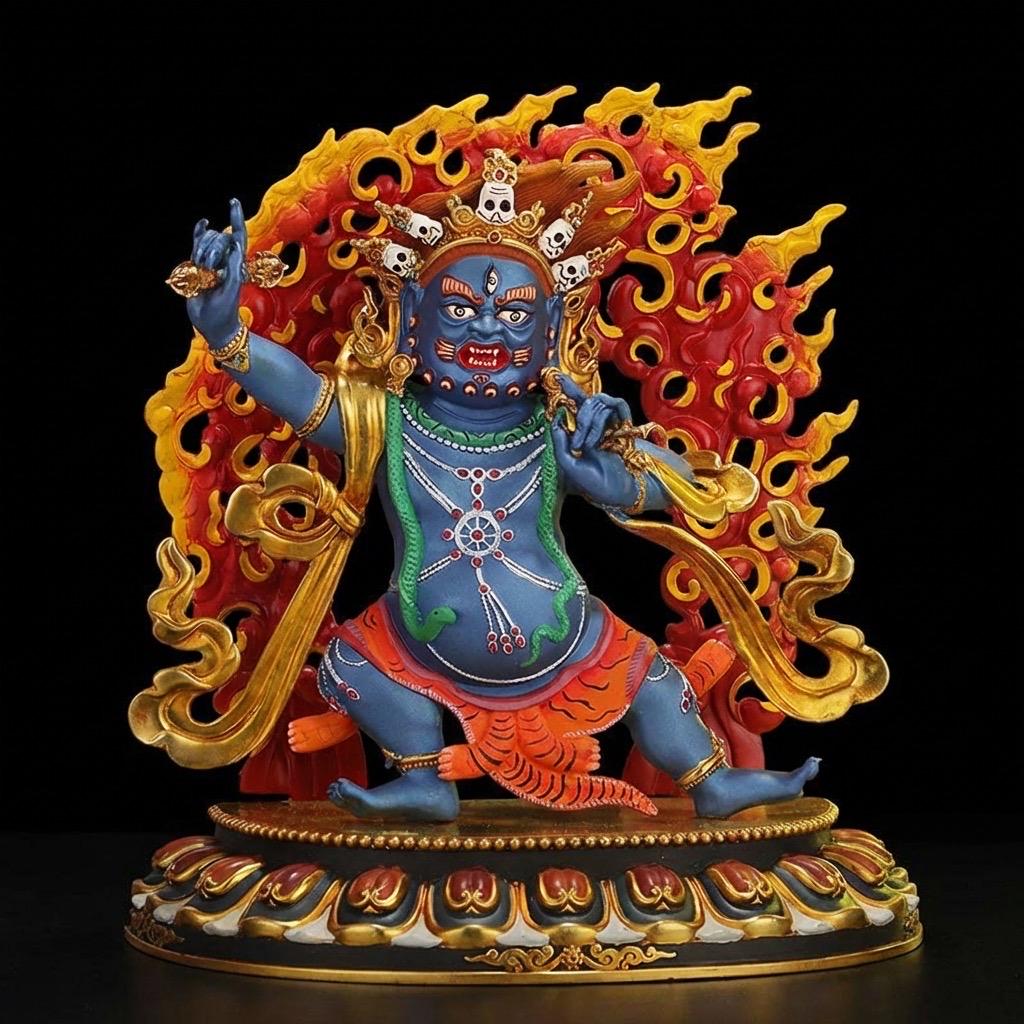
Tibetan altars often include figures with flaming halos, bared teeth and weapons raised. To a newcomer they can look frightening, yet they are among the most important images in the tradition. Here is a short guide to three of the best known and how to choose a statue.
Why some deities look wrathful
Wrathful forms are commonly explained as compassion in its most forceful mode: the fierce face is directed at obstacles such as fear, pride and confusion, not at people. Many wrathful deities are understood as fierce forms of peaceful Bodhisattvas. Some belong to specific tantric practices, so if you plan to practise with one, it is usual to ask a teacher first. As sacred art on a home altar, they are widely kept by lay families.
Vajrapani
- Look: dark blue body in a striding warrior stance, tiger-skin skirt, flaming aureole.
- Key attribute: a vajra raised in his right hand; the left hand often makes a warning gesture or holds a lasso.
- Meaning: commonly described as the embodiment of the power of the Buddhas. With Avalokiteshvara and Manjushri he forms the "Lords of the Three Families", representing power, compassion and wisdom.
Yamantaka (Vajrabhairava)
- Look: a buffalo head as the main face, often with additional faces above; many arms holding implements, standing on a buffalo or figures beneath.
- Forms: the full form has many faces, arms and legs; the "Solitary Hero" form is shown without a consort.
- Meaning: his name means "destroyer of Yama", the lord of death. He is commonly understood as a wrathful form of Manjushri, and he is especially important in the Gelug tradition.
Hayagriva
- Look: usually red, with one or more small green horse heads rising from his hair.
- Meaning: commonly linked with Avalokiteshvara; the horse's neigh is said to cut through obstacles.
Wrathful deity statues in our shop
From small bronzes to large painted statues. Browse more in our Buddha Statue collection.


Choosing a statue
- Size: a 12 cm (4.7 in) bronze suits a shelf or travel altar; 25 to 30 cm (10 to 12 in) works as a companion to a main Buddha; 50 cm (20 in) and larger is a centrepiece for a shrine room.
- Finish: painted statues show the blue or red body colour clearly, which helps identification. Gilded or plain bronze looks calmer beside peaceful images.
- Detail: check that the key attribute is visible: the raised vajra for Vajrapani, the buffalo head for Yamantaka, the horse head for Hayagriva.
- Weight: large statues can be heavy; the 54 cm (21.3 in) Vajrabhairava above weighs about 21 kg (46 lb), so plan a sturdy surface.
Placement
Wrathful deities are commonly placed to the side of the main Buddha or slightly lower, as guardians of the altar. Keep them on a clean, raised surface, dust with a soft brush and avoid polish on painted areas.


