

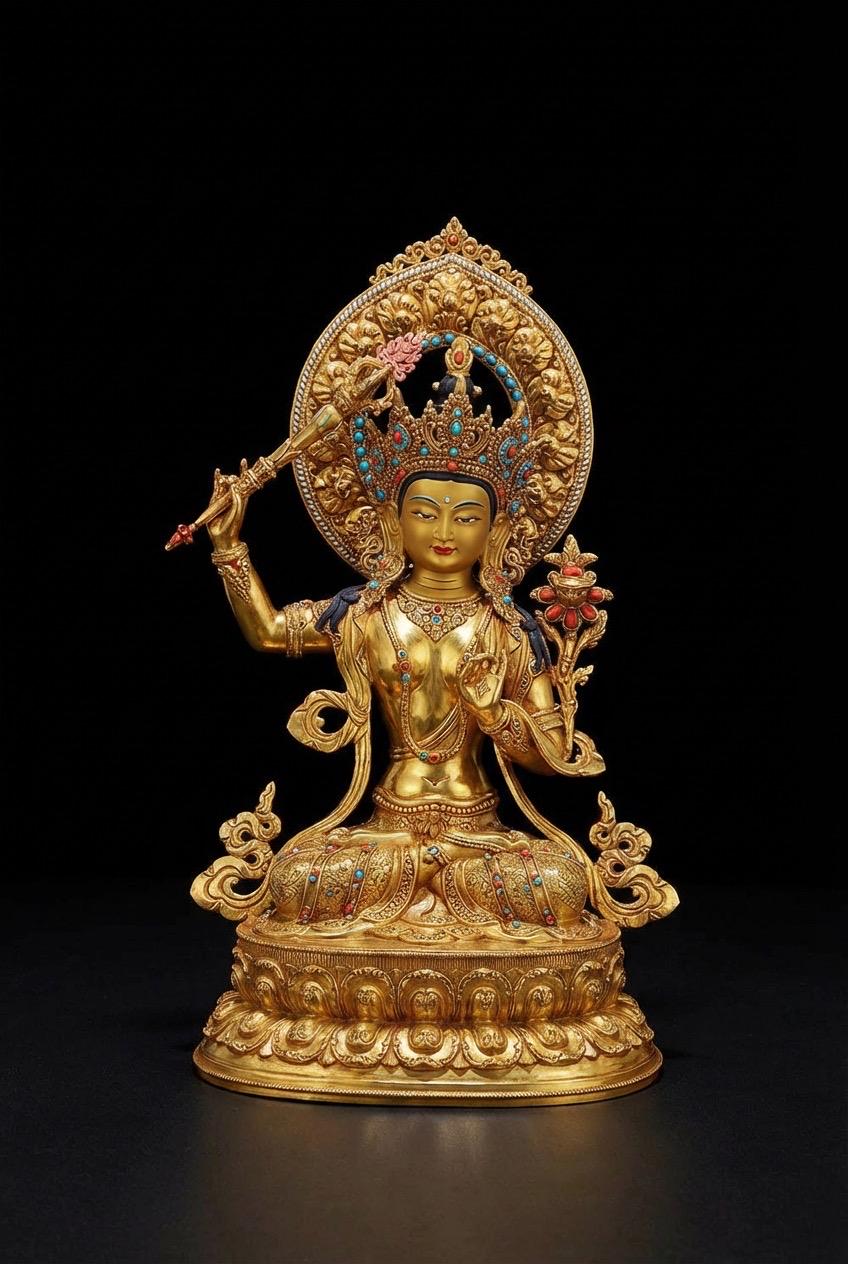
Manjushri is the bodhisattva most closely linked with wisdom. In Tibetan he is called Jampelyang, often translated as “gentle glory”. Students, teachers and people who read or write for a living are among the most common buyers of his statue. This guide explains how to recognise him and how to choose a statue that fits your space.
Who Manjushri is
In Mahayana and Tibetan Buddhism, Manjushri is commonly explained as the embodiment of the wisdom of all buddhas: the clear understanding that sees things as they are. He is usually shown as a youthful prince, which is commonly explained as a sign that this wisdom stays fresh. In Tibetan tradition he is often grouped with Avalokiteshvara (compassion) and Vajrapani (power) as three principal bodhisattvas. His mantra is usually written Om A Ra Pa Ca Na Dhih.
How to recognise a Manjushri statue
- The sword. The right hand raises a sword, often with flames at the tip. The common explanation is that it cuts through ignorance and confusion; it is not shown as a weapon against others.
- The book on a lotus. The left hand holds the stem of a lotus that opens beside the shoulder and carries a book, usually identified as a Perfection of Wisdom (Prajnaparamita) text.
- Posture and dress. He sits cross-legged on a lotus base, wearing a crown and the jewellery of a bodhisattva.
- Colour. In painted statues and thangkas his body is most often orange or golden yellow.
Some statues, especially from Nepal, show a four-armed form that adds a bow and arrow. The sword and book remain the key signs. If a figure holds a lotus but no sword, read the listing carefully: it may be a different bodhisattva, such as Tara.
Choosing a size
Manjushri statues in our shop range from a 3 cm (1.18 in) miniature to pieces 55 cm (21.7 in) tall.
- Desk or bookshelf: 3–16 cm (1.2–6.3 in). Small enough to sit beside books without crowding them.
- Home altar: 21–27 cm (8.3–10.6 in). Large enough for the face, sword and book to read clearly from across a room.
- Shrine room or centre: 36–55 cm (14.2–21.7 in). Check the weight first; a large gilded copper statue can weigh about 11 kg (24 lb).
Measure width as well as height. The raised sword and the lotus make the figure wide: a 27 cm (10.6 in) statue can be 21 cm (8.3 in) across.
Manjushri statues in our shop
Gilded, hand-painted and miniature figures. See the full Manjushri collection.


Finish: gilded, painted or antique
- Full gilding gives an even gold surface and is the most traditional look for an altar.
- Hand-painted copper adds colour to the robes, lotus and ornaments, so the details are easier to see.
- Dark antique-style finishes are common on miniatures and suit a quiet desk or shelf.
For a closer comparison, see our guide to Buddha statue materials and care.
Where to place it
A common custom is to keep the statue on a clean, raised surface, at chest height or above, and not on the floor or in a bathroom. Many people place Manjushri in a study or near a desk. On a shared altar, the Buddha usually takes the centre and bodhisattvas stand to the side.
Care
Dust with a soft, dry brush. Keep water, chemicals and metal polish away from gilded and painted surfaces. Lift the statue by its base, never by the sword, which is the most fragile part.
If you are still deciding between figures, our guide on how to choose a Buddha statue for your home covers the wider choice.


