

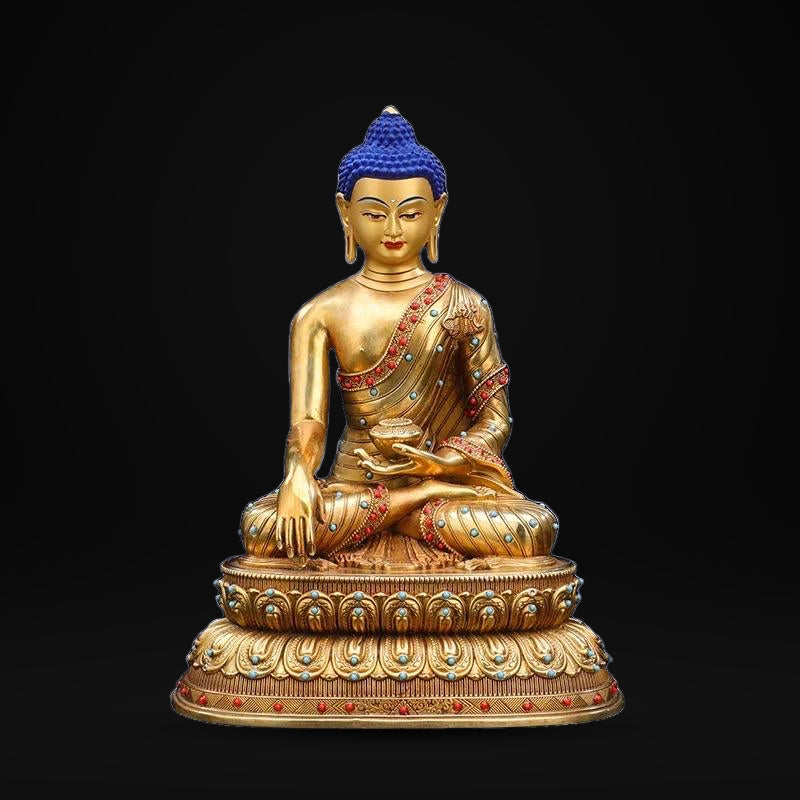
Shakyamuni is the historical Buddha, Siddhartha Gautama, who lived and taught in northern India. The name means “sage of the Shakya clan”. His is the statue most people picture when they think of “a Buddha”, and it is the most common centrepiece of a home altar. This guide explains how to recognise him and how to choose a statue.
How to recognise Shakyamuni
- Monk’s robe, no ornaments. He usually wears a simple robe, without the crown and jewellery that bodhisattvas such as Tara or Manjushri wear.
- Head and ears. Tight curls, a rounded protuberance on the crown of the head, and long earlobes.
- Alms bowl. The left hand rests in the lap, often holding a bowl.
- Seated posture. Legs crossed on a lotus base.
The hand gestures
The position of the hands, called a mudra, tells you which moment of his life the statue recalls.
- Earth-touching. The right hand reaches down over the knee, fingertips towards the ground. It is commonly explained as the moment of awakening, when he called the earth as witness. This is the most common form in Tibetan and Nepalese statues.
- Meditation. Both hands rest in the lap, palms up.
- Teaching. Both hands are held at the chest with thumbs and forefingers touching, recalling the first teaching.
- Reassurance. The right hand is raised with the palm facing out.
Shakyamuni, Medicine Buddha or Amitabha?
These three look alike in plain metal. Check the hands. Shakyamuni’s right hand usually touches the earth. Medicine Buddha’s right hand rests on the knee holding a plant stem. Amitabha holds both hands in the lap with a bowl. In painted statues and thangkas, Shakyamuni is golden, Medicine Buddha blue and Amitabha red.
Shakyamuni statues in our shop
Gilded, brass and ascetic forms. See the full Shakyamuni collection.


The ascetic Buddha
Some statues show a very thin figure seated in meditation. This is Siddhartha during his years of severe fasting before awakening. He later gave up this extreme, so the image is commonly read as a reminder of the middle way between indulgence and self-denial. It is chosen more for a study or meditation corner than as the central altar figure.
Choosing a size
Shakyamuni statues in our shop range from 11.2 cm (4.41 in) to 47 cm (18.5 in) tall.
- Desk or small shelf: around 11 cm (4.4 in).
- Home altar: 22–26 cm (8.7–10.2 in). A 26 cm (10.24 in) statue with a halo can be 20.5 cm (8.07 in) wide and 13.5 cm (5.31 in) deep, so measure the shelf first.
- Shrine room: 31.5–47 cm (12.4–18.5 in).
If Shakyamuni shares an altar with other figures, a common custom is to place him in the centre and slightly higher.
Material and care
Gold-plated copper gives a bright, even surface; gilded or painted brass costs less and often carries coloured inlay. Dust with a soft, dry brush and keep water and metal polish away from plated and painted areas. For more detail, see Buddha statue materials and care and how to choose a Buddha statue for your home.


