

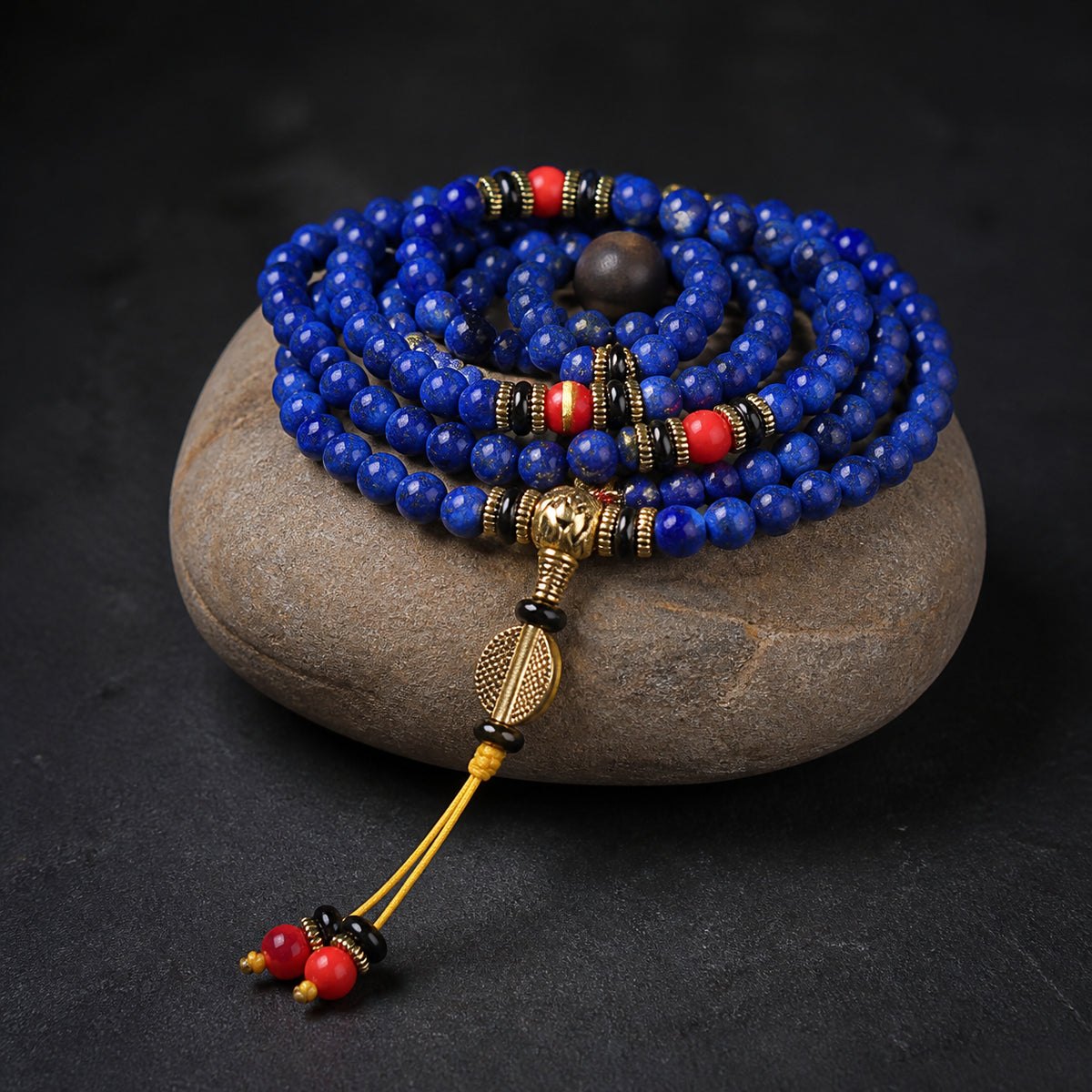
Deep blue flecked with gold, lapis lazuli has been prized across Asia for thousands of years. In Tibetan jewelry it often appears beside turquoise and coral, and on its own as a full mala. This guide covers what it is, why it matters, how to spot imitations and how to look after it.
What lapis lazuli is
Lapis is not a single mineral but a rock. Its blue comes from lazurite, often with white streaks of calcite and small golden specks of pyrite. The best-known sources are in the mountains of Afghanistan, which have supplied the stone for millennia.
It is softer than quartz, at around 5 to 5.5 on the Mohs scale, so it scratches more easily than agate or crystal and needs a little more care.
Lapis in Tibetan tradition
Ground lapis was the source of the deep blue (ultramarine) pigment used in traditional painting, including thangkas and hand-painted tsa tsas. The Medicine Buddha is usually shown with a deep blue body, and his name is commonly translated as "Master of Healing, King of Lapis Lazuli Light". A common explanation is that the stone's colour came to stand for clarity and healing for this reason. You can read more about painted deity pendants in our tsa tsa pendant guide.
Genuine, dyed or imitation
Because good lapis is valuable, look-alikes are common. The most frequent are dyed jasper or howlite, reconstituted lapis (crushed stone bonded with resin) and sodalite, a different blue stone.
- Golden flecks: scattered pyrite is a good sign of natural lapis; sodalite rarely has it.
- Colour that is too perfect: a flat, inky blue with no variation can point to dye.
- Colour in the cracks: dye often collects in fissures and around drill holes.
- Cloth test: rub an inconspicuous spot with a cloth and a little nail polish remover. Blue on the cloth means dye. Natural lapis leaves nothing.
White calcite streaks are normal in natural lapis; fewer streaks and more even blue simply mean a higher grade.
Lapis Lazuli Malas and Bracelets
A full lapis mala, a mixed-stone bracelet and a bone bracelet with lapis inlay, from our Lapis Lazuli collection.


How to choose
Full lapis or mixed stones
A mala made entirely of lapis gives the strongest colour. Mixed designs pair lapis with stones such as tiger eye or with bone, which suits people who want a touch of blue rather than a whole strand.
Bead size
- 6 mm (0.24 in): light and comfortable for a 108-bead mala that wraps around the wrist.
- 8 mm (0.31 in): fuller colour and easier to count with during recitation.
For a single-strand bracelet, measure your wrist and add about 1 to 2 cm (0.4 to 0.8 in). Our bracelet size guide explains how.
Pairing with turquoise
Blue lapis with turquoise and red stones is a classic Himalayan combination. If you like that look, see our guide to turquoise in Tibetan jewelry.
Caring for lapis lazuli
- Keep it dry: take it off before washing, showering or swimming. Water and soaps can dull the surface over time.
- Avoid perfume, lotions, cleaning products and ultrasonic cleaners.
- Wipe with a soft, dry cloth after wearing.
- Store it away from harder stones and metal, which can scratch it.
Treated gently, lapis keeps its deep colour for many years and develops a soft, worn-in glow.


