

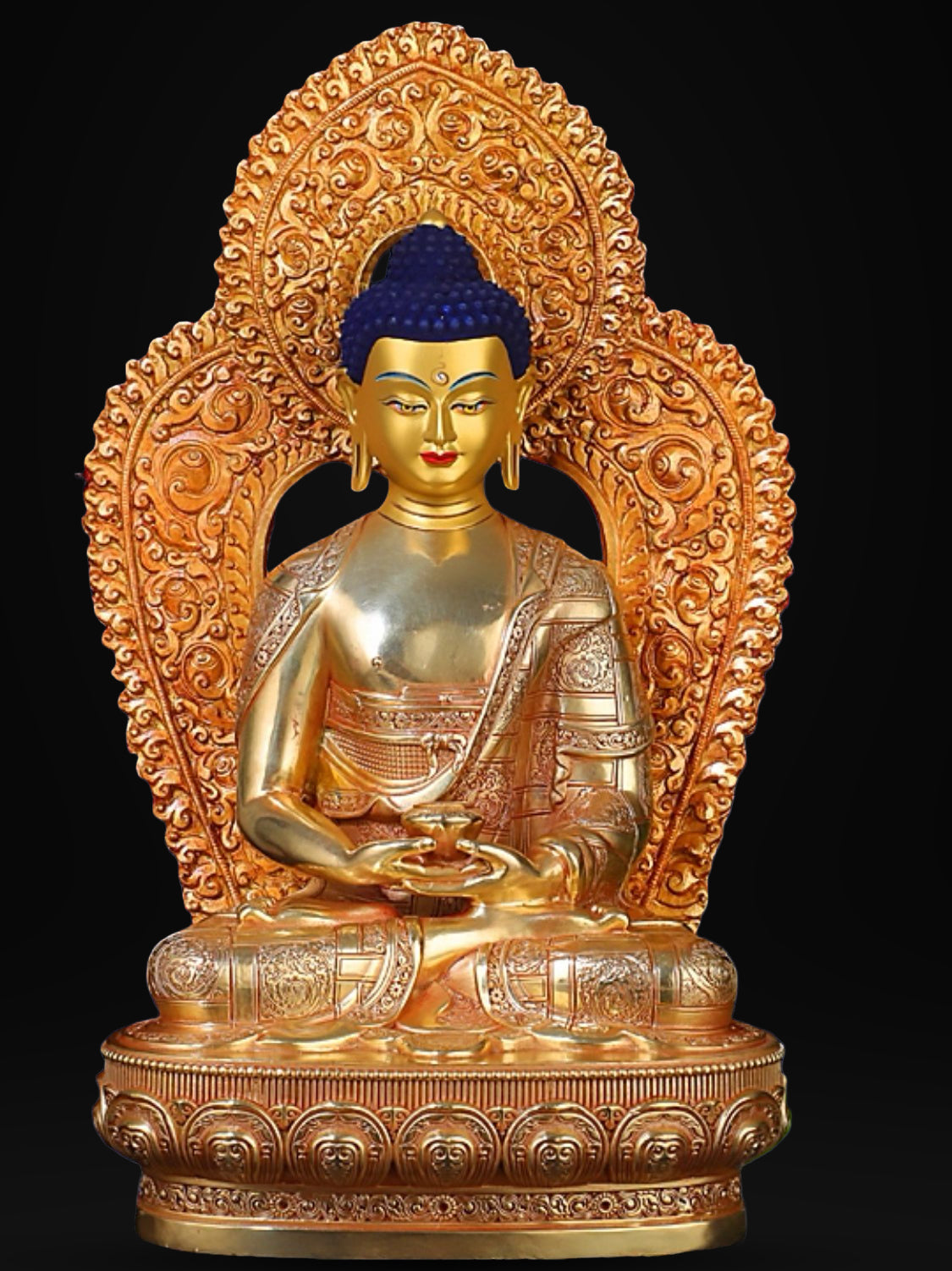
Amitabha and the Medicine Buddha are two of the most popular Buddha statues for home altars, and they are easy to confuse: both sit in full lotus, both wear simple monastic robes and both hold a bowl. A few details tell them apart.
Quick comparison
| Amitabha | Medicine Buddha | |
|---|---|---|
| Colour in painted art | Red | Deep blue |
| Hands | Both hands resting in the lap in meditation, holding a bowl | Left hand in the lap holding a bowl; right hand on the right knee, palm outward, holding a plant stem |
| Commonly associated with | Boundless light, the Pure Land and the time of death | Healing of body and mind |
Amitabha, the Buddha of Boundless Light
Amitabha's name means "Infinite Light". In Tibetan painting he is red, and he sits with both hands in his lap in the meditation gesture, usually holding an alms bowl. A common explanation is that he presides over Sukhavati, the western Pure Land, which is why many people keep his image for prayers for the dying and for loved ones who have passed away.
The Medicine Buddha
Known in Sanskrit as Bhaisajyaguru and in Tibetan as Sangye Menla, the Medicine Buddha is shown deep blue, the colour of lapis lazuli. His left hand holds a bowl in his lap, and his right hand rests on his knee in the gesture of giving, holding a sprig of the arura (myrobalan) plant, which is valued in Tibetan medicine. People often choose him when praying for their own health or for someone who is ill.
Telling them apart on an unpainted statue
On brass or gilded statues the body colour may not show, so look at the right hand:
- Right hand in the lap with the left: Amitabha.
- Right hand on the knee holding a plant: Medicine Buddha.
- Right hand reaching down to touch the ground, no plant: usually Shakyamuni Buddha. See our Shakyamuni hand gesture guide.
Amitabha and Medicine Buddha Statues
Painted, gilded and brass statues for the home altar. Browse more in our Buddha Statue collection.


How to choose
By intention
Many people choose Amitabha for a memorial corner or for prayers for those who have died, and the Medicine Buddha for a space dedicated to healing and wellbeing. Both are also simply peaceful images for daily practice.
Size
- About 15 to 20 cm (6 to 8 in): fits a shelf or a small altar.
- About 25 to 35 cm (10 to 14 in): a clear centrepiece for most home altars.
- Over 40 cm (16 in): for a large altar or shrine room.
Finish
Painted statues make the identifying colours obvious. Full gilding gives a rich, traditional look, while plain or antique-finished brass is quieter and often more affordable. Our guide to Buddha statue materials compares them in more detail, and how to choose a Buddha statue for your home covers placement.


