

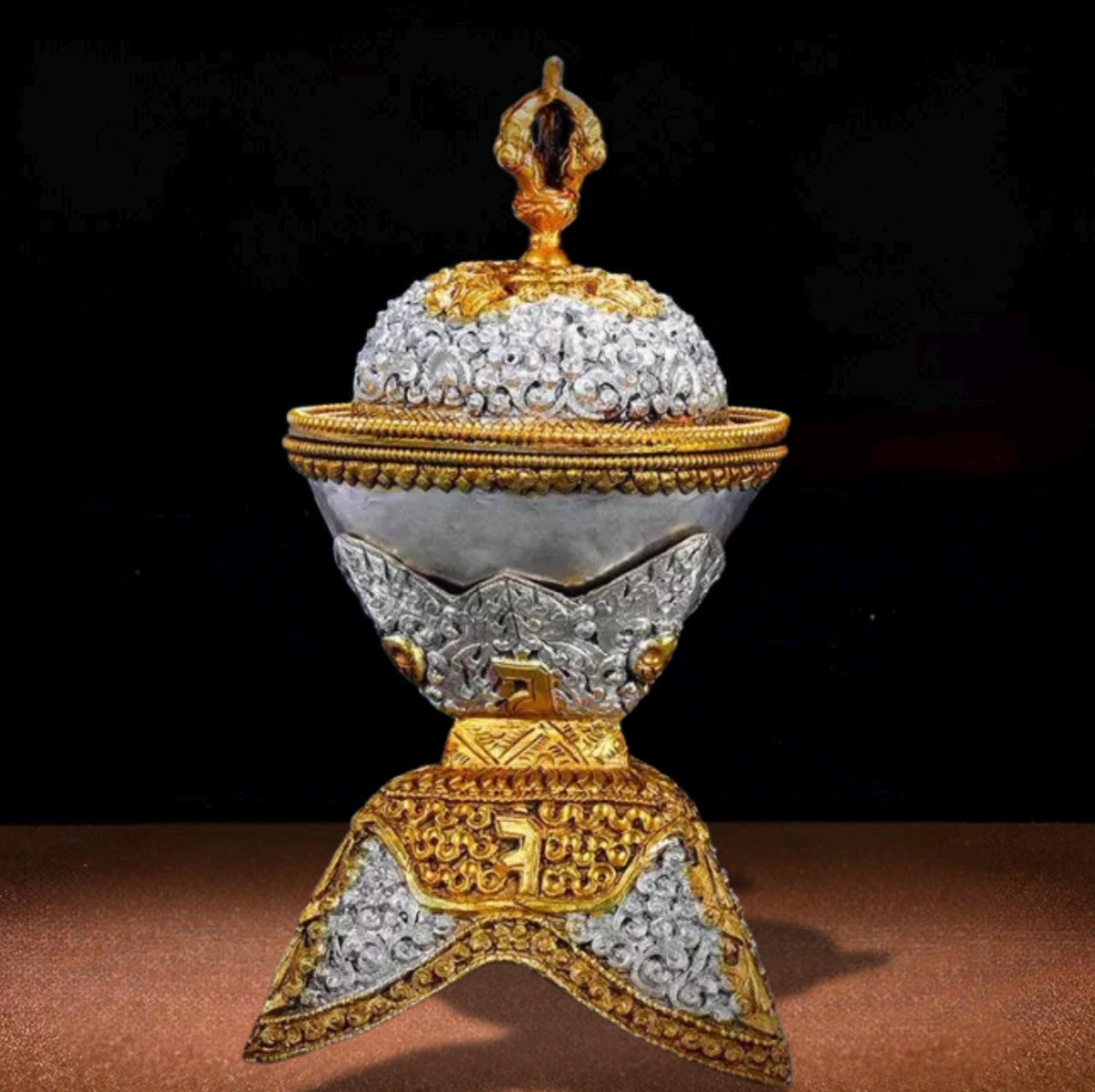
A kapala is a cup shaped like the top of a human skull. It is one of the more striking objects in Tibetan Buddhist art, and many people first notice it in the hand of a deity on a statue or thangka. This short guide explains what it is and how to choose one for an altar or display.
What the word means
Kapala is a Sanskrit word for skull or skull cup. In Tibetan it is often called thod pa. In Vajrayana Buddhism the skull cup is a ritual vessel and a common attribute in religious art.
What it is commonly said to represent
The usual explanation is that the skull is a direct reminder of impermanence: life is short, and attachment to the body is let go. In paintings and statues, wrathful protectors and dakinis often hold a kapala filled with nectar (amrita) or blood, which is commonly read as turning ordinary experience into wisdom. Guru Rinpoche is also frequently shown holding a skull cup in his left hand.
Meanings and ritual uses vary between lineages. If you practise within a tradition, ask your teacher how a kapala should be used on your altar.
The parts of a kapala set
- Cup: the oval bowl, often decorated around the rim.
- Lid: on many sets, a domed cover, sometimes topped with a small vajra handle.
- Stand: a base that holds the oval cup level, often triangular and decorated with skulls or flames.
Some pieces are sold as a full set and some as a bowl or stand only, so check what is included before you order.
Kapalas in our shop
A gilded copper set, a resin replica and a statue showing the kapala in iconography. See more ritual items in Vajra Bell Set, Phurba.


Metal or resin?
Historically some kapalas were made from real skulls. The kapalas sold for altars and display today are almost always made of metal or resin.
- Metal (copper or brass): heavier and more durable, often gilded or silvered and finely detailed. A Nepalese gilded copper set of about 11 cm (4.3 in) wide and 20 cm (7.9 in) tall, with lid and stand, weighs around 0.7 kg (1.5 lb). A good choice for a long-term altar piece.
- Resin replica: lighter and usually more affordable, with a bone-like surface. It is a decorative piece; it is not meant for liquids or food, and it should be kept away from heat and flames.
How to choose
- For a home altar: a metal set with lid and stand looks complete and stays stable.
- For display or a collection: a resin replica shows the traditional form at a lighter weight.
- Size: measure your shelf. A cup on a stand needs more height than you might expect; 20 cm (7.9 in) is a typical full-set height.
- Prefer imagery to an object: a statue of a deity holding a kapala, such as Guru Rinpoche, carries the same symbol.
Placing and caring for a kapala
A kapala is usually placed on the altar at or below the level of the main images, often near a protector or deity with whom it is associated. Keep it on its stand so it sits level. Dust metal pieces with a soft dry cloth and avoid polish on gilded surfaces; keep resin away from direct sun, heat and solvents. Lift the cup and stand separately when moving the set.


