

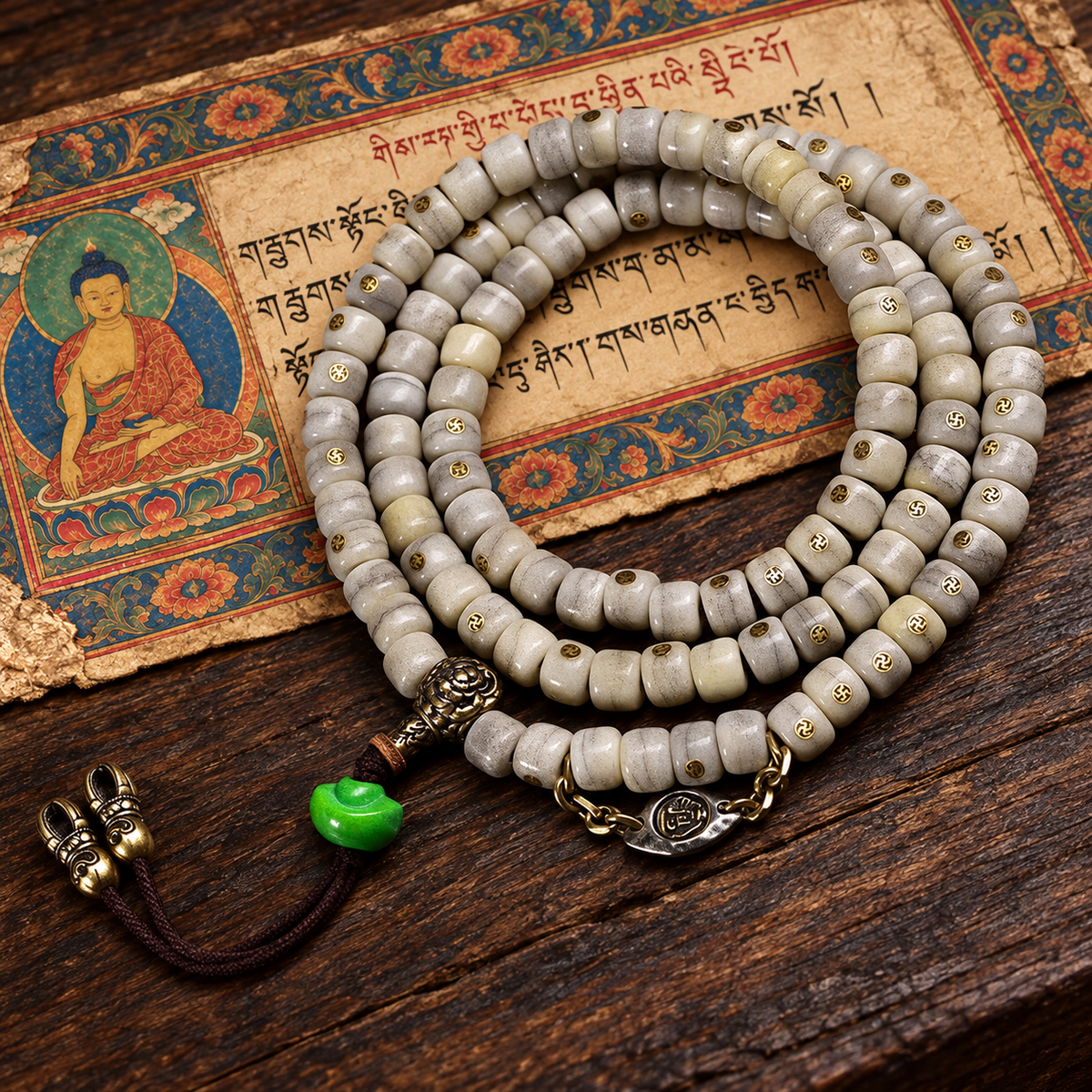
Some Tibetan malas and bracelets carry a small cross-shaped symbol with bent arms. In Buddhism this is the wan symbol, and it is thousands of years old. Because a similar shape was later misused in Europe, many buyers have questions. This short guide explains the symbol honestly so you can decide what feels right for you.
What the wan symbol means
The symbol is far older than the 20th century. In Sanskrit it is called svastika, usually translated as "well-being" or "good fortune", and it appears in Buddhist, Hindu and Jain art across Asia. In Chinese Buddhism it is written as the character wan and is often shown on the chest of the Buddha, where it is commonly explained as a sign of the Buddha's virtue and auspiciousness.
In Tibet the symbol is called yungdrung and is commonly linked with permanence and the unchanging. It is found on doors, textiles, altar cloths and jewellery. Both directions, with the arms pointing clockwise or anticlockwise, appear in Asian religious art; in Tibet the anticlockwise form is often associated with the Bon tradition.
How it differs from the Nazi emblem
In the 1920s the Nazi party adopted a version of the shape as its emblem. That version is usually drawn tilted at 45 degrees, in black inside a white circle on a red ground. The Buddhist symbol is normally upright, often small and gold or red, and appears in a religious context. The meaning in Buddhist art is entirely unrelated to Nazi ideology.
Wan symbol malas in our shop
Yak bone malas and bracelets with small antique copper or inlaid wan details. Browse more Tibetan Malas.


What to consider before wearing one
- Context matters: in Asia the symbol is everyday and positive. In Europe and North America many people only know the Nazi version, so some may misread it at first glance.
- Size and placement: on most malas the wan appears as a few small inlays or metal beads. A wrist mala or a mala kept in a pouch for practice draws little attention.
- Local law: a few countries regulate the public display of Nazi symbols. Religious use is generally treated differently, but if you are unsure, check local rules or choose a design without the symbol.
- Your own comfort: if explaining it would feel awkward, there are many beautiful malas without the wan. If you value its original meaning, a short explanation usually clears up confusion.
Care
Yak bone and copper-tone beads need only a soft dry cloth. Keep the mala away from water, perfume and lotions, and expect the bone to slowly darken to a warm honey tone with handling.


