

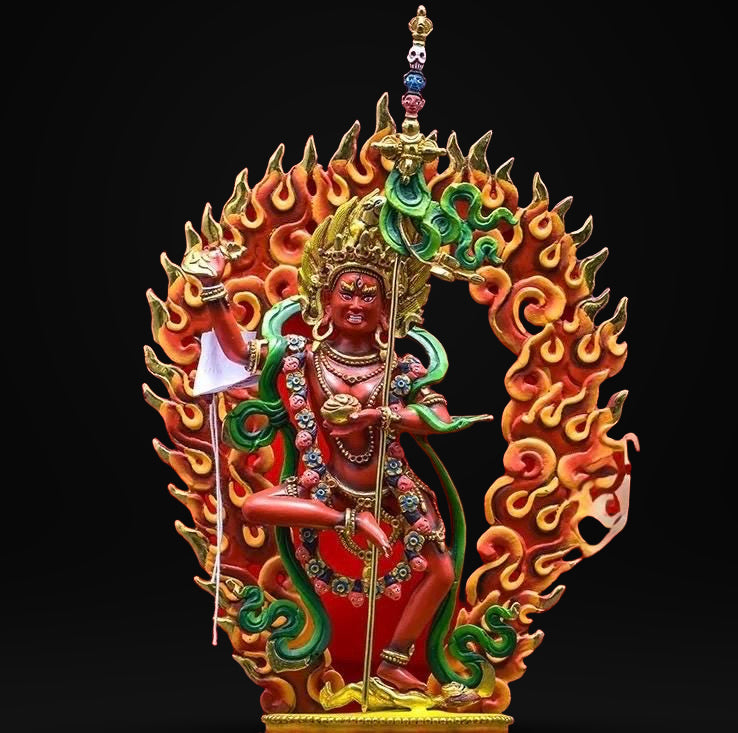
Vajrayogini and Vajravarahi are two of the most recognisable female figures in Tibetan Buddhist art. They are closely related, look alike at first glance, and are often confused in shop listings. This short guide explains how they are commonly described, how to tell them apart, and what to look for in a statue, tsa tsa or mala pendant.
Who are Vajrayogini and Vajravarahi?
Both are usually described as female meditation deities (yidam) and dakinis of the highest tantra class. Vajrayogini's name is often translated as "Diamond Yogini." Vajravarahi means "Diamond Sow," and a common explanation is that she is a form or aspect of Vajrayogini, closely linked with the Chakrasamvara cycle of teachings. Different lineages emphasise different forms: Vajravarahi is especially prominent in Kagyu practice, while the Naro Khachö form of Vajrayogini is well known in the Sakya and Gelug traditions.
In Tibetan tradition, the meditation practice itself is generally taught only after an empowerment from a qualified teacher. Keeping her image on a home altar as a sign of respect is common and needs no special permission.
How to recognise them
Shared features
- A red body, in the appearance of a young woman
- A curved flaying knife (kartika) in the right hand, often raised
- A skull cup (kapala) in the left hand
- A khatvanga staff resting against the left shoulder
- Bone ornaments, a garland of heads or skulls, and a flaming background
The main difference
The clearest sign of Vajravarahi is a small sow's head, usually above or beside her right ear. Vajrayogini in the Naro Khachö form typically stands with her head tilted upward, drinking from the skull cup, without the sow's head. Pose varies by lineage, so check the sow's head first.
Vajravarahi and Vajrayogini pieces in our shop
A painted statue, a wearable tsa tsa and a mala pendant. Browse more in Buddha Statues and Tsa Tsa.


Statue, tsa tsa or mala pendant?
Statue
A statue suits a home altar or shrine shelf. Our hand-painted copper Vajravarahi measures 13 × 9.5 × 27 cm (5.12 × 3.74 × 10.63 in) and weighs about 1.6 kg (3.6 lb), so allow a shelf at least 15 cm (6 in) deep. Look for clear detail in the face, the knife and skull cup, and the sow's head.
Tsa tsa pendant
A tsa tsa is a small painted clay or plaster image. Ours is 3.7 × 5.4 cm (1.46 × 2.13 in) and sealed in a waterproof acrylic case, which makes it practical for daily wear or a small travel altar.
Mala with pendant
If you already recite mantras, a mala keeps the image close during practice. Our yak bone 108-bead strand has main beads of about 8 × 6 mm (0.31 × 0.24 in) and a Vajrayogini-inspired pendant.
Placement and care
A common custom is to place the image at or above eye level, on a clean surface, and not on the floor. Dust a painted statue with a soft, dry brush; avoid water and polish, which can lift paint. Keep tsa tsa and bone pieces away from damp and long soaking.


