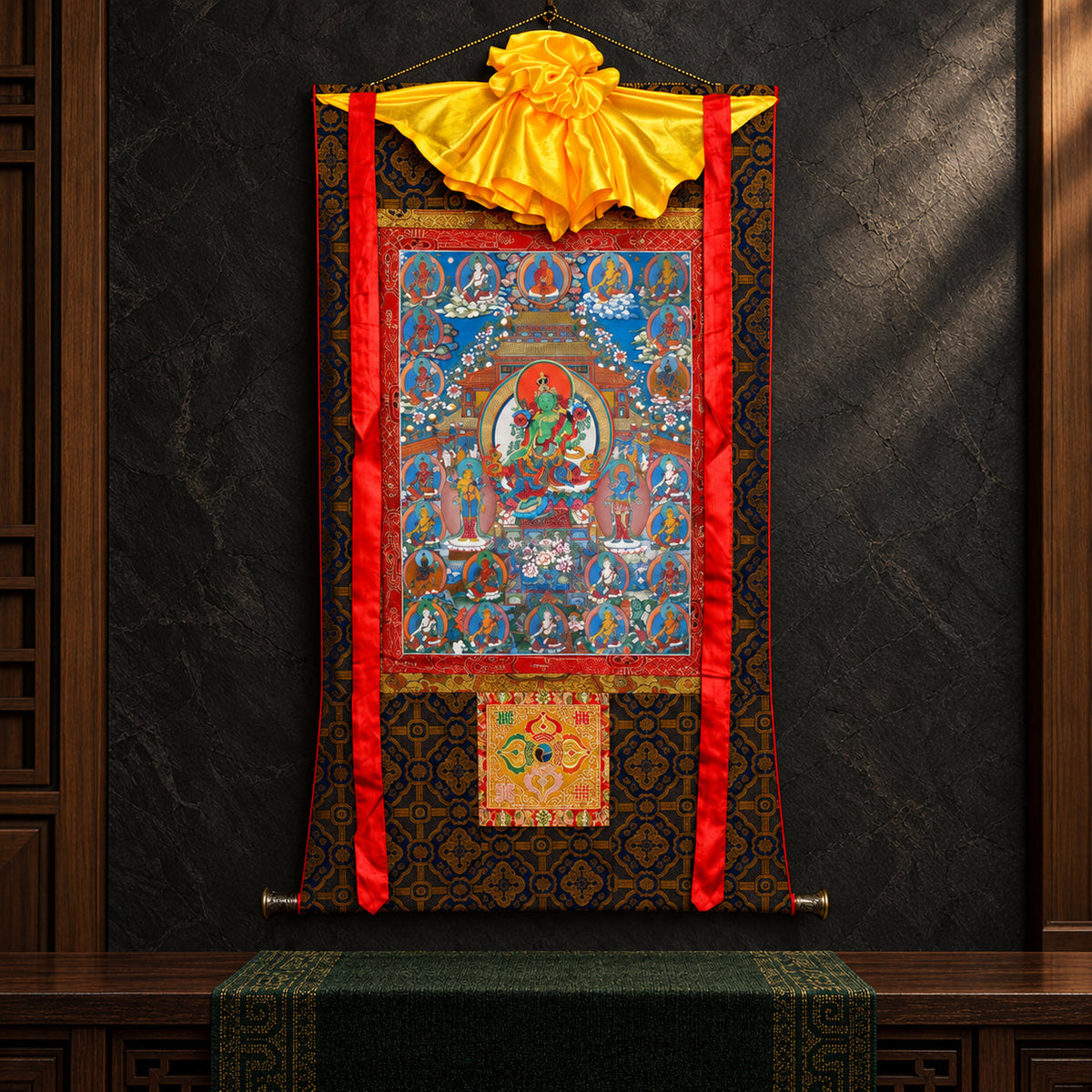
A Twenty-One Tara thangka is one of the most popular pieces of Tibetan devotional art, and one of the most confusing to read: twenty-one female figures in different colours, all called Tara. This guide explains who the Twenty-One Taras are, how a painting is usually laid out, and how to choose a thangka, statue or mala.
Who are the Twenty-One Taras?
Tara is a female Buddha closely linked with compassion and swift help. In Tibetan Buddhism she is commonly explained as appearing in many forms, and a set of twenty-one is the best known. The set comes from a short prayer, often called the Praise to the Twenty-One Taras, which salutes Tara in twenty-one verses. Each verse is traditionally connected with one form of Tara, and the prayer is recited daily in many Tibetan households and monasteries.
The forms are usually grouped by colour and activity. The common explanation is that white forms are associated with pacifying, yellow with increasing, red with magnetising, and dark or black forms with wrathful protection.
How a Twenty-One Tara painting is laid out
In many paintings a large Green Tara sits at the centre, with the other twenty arranged around her in rows or in a ring of smaller figures. Green Tara is shown seated, her right leg extended ready to step forward, which is why she is the familiar central figure. Sometimes the central figure is counted as the first of the twenty-one.
Different traditions, different pictures
There is more than one iconographic system, so two Twenty-One Tara thangkas can look quite different:
- Atisha tradition: the twenty-one look much alike in posture and differ mainly in colour, which gives the painting a calm, even rhythm.
- Suryagupta tradition: each Tara has a more distinct form, with different numbers of arms, attributes and expressions, including wrathful ones.
- Chogyur Lingpa (Nyingma) tradition: a later revealed system with its own descriptions.
Regional painting styles also differ. Central Tibetan works often fill the whole surface with figures and ornament, while paintings from eastern Tibet tend to leave more open sky and landscape.
Tara in our shop
A Twenty-One Tara wall hanging, a Green Tara statue and mala. See more in Thangkas and Green Tara.


How to choose
A thangka or a single statue?
A Twenty-One Tara thangka suits someone who recites the praise or wants the whole assembly in view. If you prefer one clear focus for an altar, a single Green Tara statue is simpler. Many people combine the two: the thangka on the wall and a small statue below it.
Size
Our Twenty-One Tara wall hanging comes in sizes from 65 cm (26 in) to 200 cm (79 in), measured on the mounted piece. Because there are twenty-one figures, a larger size makes each Tara easier to see; 90 cm (35 in) or more is a good start for a living room wall. A 65 cm (26 in) piece suits a small shrine corner or a narrow wall.
Where to hang it
Hang it at or slightly above eye level in a clean, dry place, away from direct sunlight, heat and damp. Our thangka guide covers printed, painted and embroidered types in more detail.
Care
Dust a thangka gently with a soft, clean brush; do not wash it or apply chemicals, and avoid touching the image. For storage, roll it loosely without sharp folds. To learn more about the two best-known Taras, see Green Tara vs White Tara.