

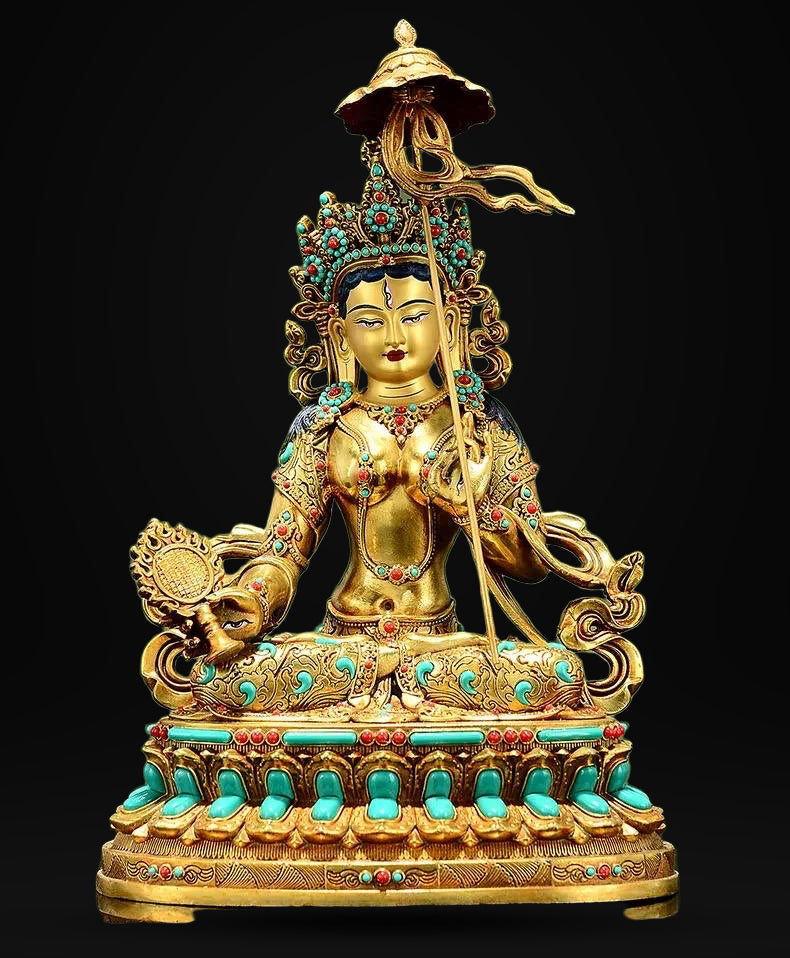
Among Tibetan protective deities, few are as striking as Sitatapatra, the goddess of the White Umbrella. Her many-headed, many-armed form fills a whole altar, while her simple form is calm and gentle. Here is how to recognise her and choose an image.
Who Sitatapatra is
Sitatapatra means "white parasol" in Sanskrit; in Tibetan she is called Dukkar. Traditional accounts say she arose from the crown (ushnisha) of the Buddha, and her long dharani is recited for protection. The parasol, one of the Eight Auspicious Symbols, is commonly explained as shelter from harm, fear and obstacles, just as a parasol shades from the sun.
How to recognise her
Simple form
A white, peaceful goddess with one face and two arms, seated, holding the shaft of a white parasol above her. This form is quiet and easy to place on a small altar.
Thousand-armed form
The best-known form in statues is very elaborate: white, with many faces stacked in tiers, many arms fanning out like a halo, and many legs standing on figures below. Traditionally the numbers are given as a thousand faces, a thousand arms and a thousand legs; artists show this with as many as space allows. One of her main hands holds the white parasol rising above her heads.
Quick check: a white figure with many heads and arms and a parasol at the top is Sitatapatra. A many-armed white figure holding a crossed vajra and long-life vase is more likely Ushnishavijaya.
Sitatapatra in our shop
Gilded and painted statues and a thangka. Browse more in our Buddha Statue collection.


Statue or thangka?
- Statue: the tiers of heads and fan of arms are dramatic in three dimensions. Because of the detail, larger sizes show the faces and hands more clearly.
- Thangka: shows every arm and attribute flat and readable, and suits a wall where shelf space is limited.
Choosing a size
- Small altar: about 21.5 cm (8.5 in) tall; choose a clear casting so the small faces stay sharp.
- Home shrine: about 31.5 cm (12.4 in) gives room for the details to read from a seat.
- Shrine room: 46 to 54 cm (18 to 21 in) and above, on a deep, sturdy surface; the largest gilded size weighs about 8 kg (18 lb).
Finish and care
Gilded statues with coloured inlays look rich and unified; painted statues show the white body colour clearly. Dust statues with a soft brush and avoid polish. Hang thangkas away from direct sun and damp, and dust them gently without touching the painted surface.


