

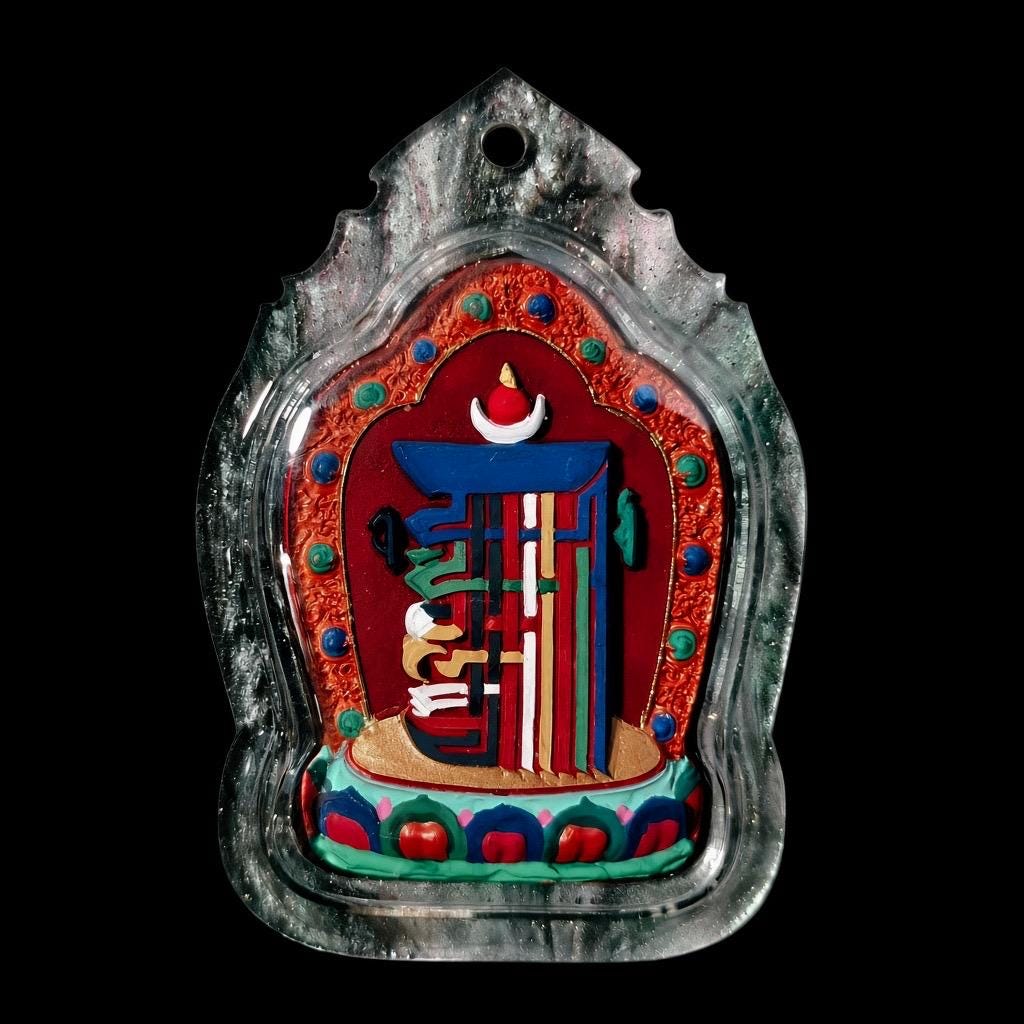
If you have seen a compact, flame-framed monogram of interlocking letters on Tibetan amulets, door hangings or temple walls, it is very likely the Kalachakra symbol, known in Tibetan as Namchu Wangden, usually translated as "the ten powerful ones" or the "ten-fold powerful" syllable. This short guide explains what the emblem is, how to recognise it and what to look for when choosing a pendant or thangka.
What is Kalachakra?
Kalachakra means "Wheel of Time" in Sanskrit. It is the name of a tantric system in Vajrayana Buddhism and of its central meditational deity. In paintings, Kalachakra is usually shown dark blue, with several faces and many arms, in union with the yellow consort Vishvamata. The teachings are widely known partly because large public Kalachakra initiations have been given by the Dalai Lama and other teachers, often together with an intricate sand mandala.
What the ten-fold powerful symbol means
The emblem combines seven Sanskrit syllables, commonly listed as ha, ksha, ma, la, va, ra and ya, stacked into a single monogram. Above them sit three further elements: a crescent moon, a sun disc or drop, and a small flame-like stroke. Seven syllables plus three symbols give the "ten" in its name.
A common explanation is that these ten elements condense the whole Kalachakra system into one image: the outer world, the body and the path of practice. For this reason the symbol is traditionally regarded as auspicious and protective, and it is often placed above doorways, painted on walls or worn as an amulet. Teachers explain the details in different ways, so treat any single interpretation as one reading among several.
How to recognise it
- A vertical stack of letters merged into one shape, rather than a row of separate characters.
- A crescent, a round disc and a small flame at the top.
- Often painted in several colours and set inside a lotus, a ring of flames or a decorative frame.
- On tsa tsa pendants the symbol may appear on its own; on thangkas it may accompany the full deity or the Kalachakra mandala.
Shop the Kalachakra symbol
Hand-painted tsa tsa pendants and a thangka wall hanging. See more in our Tsa Tsa collection and Thangkas collection.


How to choose
Pendant or amulet
Choose a pendant if you want to carry the symbol with you. Check the listed size: our Kalachakra tsa tsa pendants measure about 4.6 cm (1.81 in) wide, or 4.8 × 4.0 cm (1.89 × 1.57 in), a size that sits comfortably on the chest. Both are hand-painted medicinal clay in a protective case, and each product page lists what is placed inside, such as five-colour rice and nectar pills. Decide whether you prefer the syllable monogram on its own or the fuller Kalachakra mandala design.
Thangka wall hanging
Choose a thangka if you want the image on a shrine or wall. Our Kalachakra thangka wall hanging comes in sizes from 65 cm (26 in) up to 200 cm (79 in). Measure your wall first and leave some space above and below the scroll: smaller sizes suit a home altar, larger ones a meditation room.
Wearing and care
Many people treat Buddhist amulets with simple respect: keep them clean, avoid soaking them, and when not wearing them, store them in a clean, raised place rather than on the floor. For a thangka, hang it away from direct sunlight, damp and heat, dust it gently with a soft brush, and roll it loosely for storage without sharp folds.


