

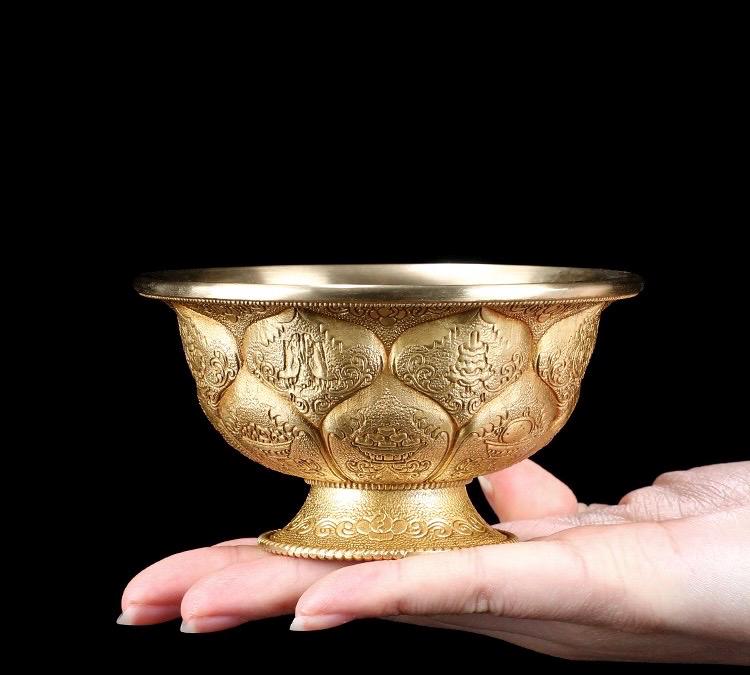
Water offering bowls are often the first items people buy for a home altar. They are simple objects, but a few choices matter: how many, what material, what size, and how to set them out.
How many bowls?
Seven is the usual number in Tibetan Buddhist practice. A common explanation is that the seven bowls stand for the offerings made to an honoured guest: water to drink, water to wash, flowers, incense, light, perfume and food. Another explanation links them to the seven-limb prayer. Some traditions set out eight, adding music.
If your space is small, some teachers say fewer bowls can be offered. Many bowls in our collection are sold as single pieces or as a set of seven, so check the option before ordering. Single bowls are also useful for replacing one from a set.
Material
- Brass and copper: the traditional choice. Durable and stable, but they mark and tarnish if left wet, so dry them after each use.
- Silver-plated or gilded: brighter on the altar. Clean with a soft cloth only, since abrasive polish wears plating.
- Glass: does not tarnish and shows the water level clearly. It is more fragile.
Tradition does not ask for costly bowls. The usual advice is that any material is suitable, as long as the bowls are clean and kept only for offerings.
Size
Measure your shelf first. Seven bowls sit in one row with small gaps. Seven bowls of about 7.5 cm need a little over 52 cm of width; seven of about 10 cm need more than 70 cm. On a narrow shelf, choose the smaller size rather than crowding the row.
Offering bowls from our collection
Browse all offering bowls and cups.


Placement and daily use
- Set the bowls in a straight line in front of the images on your altar.
- Leave a small gap between bowls. The width of a grain of rice or barley is the measure commonly taught.
- Fill from left to right, stopping just below the rim.
- Empty bowls are not left upright on the altar. Keep them upside down until you fill them.
- In the evening, empty the bowls, dry them with a clean cloth and turn them over. The water is often given to plants.
Customs vary between lineages, so follow your own teacher's instructions where they differ.
For the meaning behind each bowl, read the symbolism of Tibetan offering bowls.


