

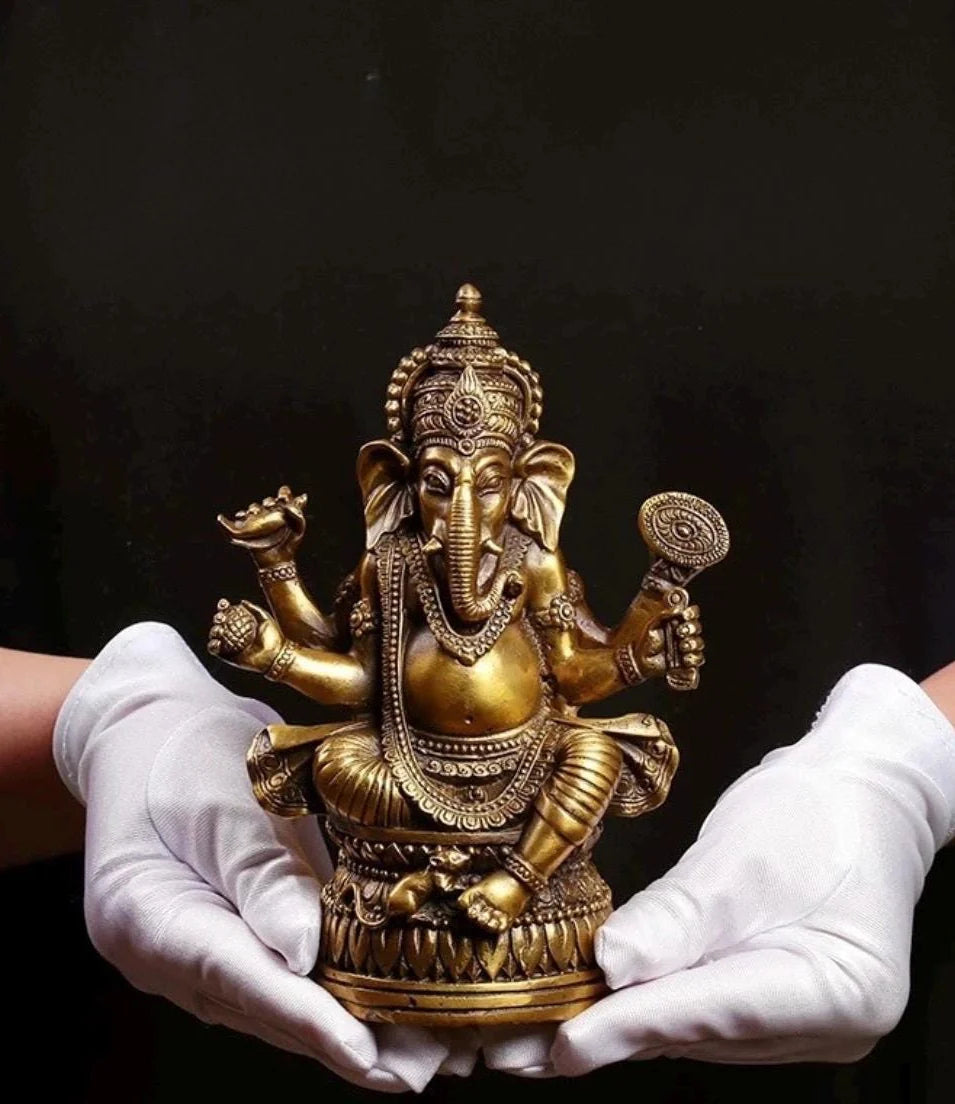
Ganesha, the elephant-headed deity, is one of the most recognisable figures in Asian sacred art. He is deeply loved in Hindu tradition and also appears, as Ganapati, in the Buddhist art of Nepal and Tibet. This guide explains what he represents, how to recognise his form and how to choose a statue.
What Ganesha represents
In Hindu tradition Ganesha is commonly described as the remover of obstacles and the lord of beginnings, so he is often honoured before a new home, a journey, exams or a new business. He is also linked with wisdom and learning.
In Tibetan Buddhism he appears in more than one role. In the Sakya school, a red form called Maharakta Ganapati is one of the “three great red deities” and is generally described as a deity of wealth and of removing obstacles. In images of the six-armed Mahakala, an elephant-headed figure lies beneath the protector’s feet; this is usually explained as obstacles being overcome rather than as an insult to Ganesha.
How to recognise Ganesha
- Elephant head: often with one tusk broken.
- Rounded belly: commonly said to hold the whole universe, or simply to show contentment.
- Several arms: usually four, holding items such as a noose, an elephant goad and a bowl of sweets (modak); one hand may be raised in blessing.
- The mouse: his small mount often sits at his feet.
Ganesha in the shop
A brass statue plus incense trays and holders with a Ganesha design. Browse more in Ganesha.


How to choose a Ganesha statue
- Size: a statue of about 18 cm (7.09 in) high and 7.5 cm (2.95 in) wide, like our brass Ganesha, suits a shelf, desk or small altar.
- Posture: a seated Ganesha has a calm, settled look for a home; standing and dancing forms feel more lively.
- Trunk direction: a popular belief holds that a trunk curving to Ganesha’s left is the gentler choice for homes, while a right-curving trunk is associated with stricter worship. Many families simply choose the image they find most beautiful.
- Material: brass with an antique bronze finish is durable and develops a soft patina over time.
- Incense pieces: if you want Ganesha near your daily incense, a holder or tray with a Ganesha design is a small, practical option; our leaf-shaped trays are about 22 cm (8.7 in) long and 5–5.5 cm (2.0–2.2 in) wide.
Placement and care
Common guidance is to place Ganesha on a clean, raised shelf or altar rather than on the floor, away from bathrooms and shoes, often near the entrance or in a calm corner of the main room. Some follow the Vastu suggestion of the north-east. Dust the statue with a soft brush, wipe it with a dry cloth, and avoid metal polish, which can strip an antique finish. When burning incense nearby, keep the holder on a heat-resistant surface and never leave it unattended.


