

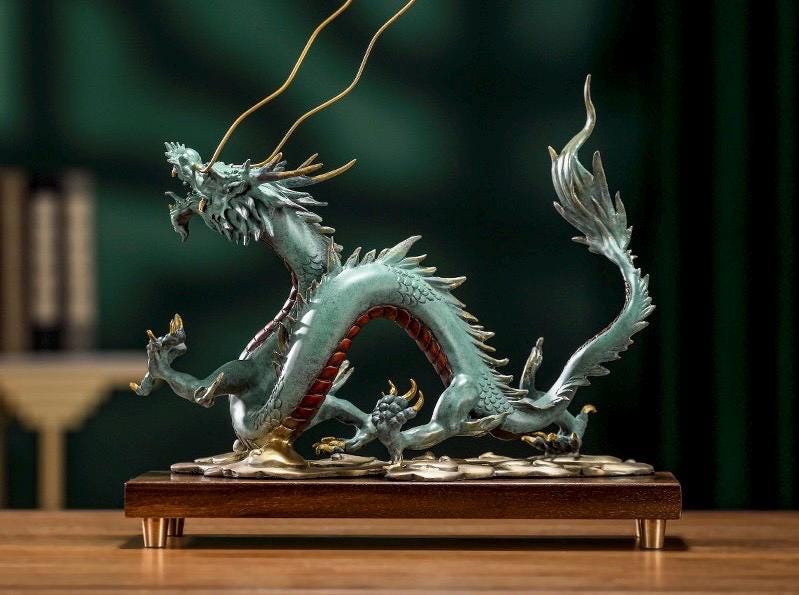
Dragon, Pi Xiu and Qilin statues often sit next to each other in a shop, and at first glance they can look alike: scaled bodies, fierce faces, brass or copper. They are three different creatures from Chinese tradition, each with its own meaning. This guide shows how to tell them apart and how to choose one.
How to recognise each one
Dragon (Long)
A long, snake-like body with four short legs and clawed feet, a horned head with whiskers, and no wings. It is often shown among clouds or waves, sometimes chasing a pearl.
Pi Xiu
A stocky, lion-like body with paws, a dragon-like head with a wide open mouth, and usually small wings. It may have one horn or two. It is normally shown crouching or striding, head raised.
Qilin (Kirin, Kylin)
The easiest sign is the feet: a Qilin has hooves, like a deer or ox. The body is scaled, the head is dragon-like with one or two horns, and the tail is bushy. It usually stands upright on four legs.
What each is said to stand for
- Dragon: the common explanation is power, good fortune and rain. In Chinese tradition the Azure Dragon is linked with the east and with spring. The dragon also appears in Tibetan art, where it is called druk, the thunder dragon.
- Pi Xiu: popularly described as a creature that swallows gold and silver and never lets them out, which is why it is associated with gathering and keeping wealth. Shop owners often keep one near the till or the entrance.
- Qilin: traditionally a gentle creature said to appear in times of peace or at the birth of a wise person. It is associated with benevolence, family blessings and protection of the home, and is often displayed in pairs.
These are folk and feng shui meanings, not Buddhist teachings. A statue is a symbol and a piece of craft; it does not guarantee any result.
Dragon, Pi Xiu and Qilin statues in our shop
Brass and copper pieces for desks, shelves and entrances. See the full Dragon collection.


How to choose
Start with the meaning
Choose a dragon for a general symbol of strength and good fortune, a Pi Xiu for a shop, office or desk where the theme is wealth, and a Qilin for a home or as a housewarming or family gift.
Size
Measure the spot first. A desk piece is usually around 10–15 cm (4–6 in) tall; our brass Qilin is 14.5 cm (5.7 in) tall and 20 cm (7.9 in) long. A statement piece for a console or cabinet is larger: our brass dragon measures 31 × 13 × 33 cm (12.2 × 5.1 × 13 in). Check the weight too; solid metal is heavy, and a 650 g (1.4 lb) figure needs a stable shelf.
Material and finish
Brass has a warm yellow tone; copper is redder; an aged green patina gives an antique look. Read the product page for the exact metal, and decide whether you prefer a bright or a darkened surface.
Where to place it
Common feng shui advice is to place a dragon on the east side of a room, to turn a Pi Xiu so its head faces the door or window, and to stand Qilin in pairs facing outward near an entrance. Opinions vary between schools, so treat these as customs rather than rules. A clean, stable surface at about waist height or above is a sensible choice for any of them.
Care
Dust with a soft dry cloth. Avoid water, metal polish and chemical cleaners, which can strip a patina or coloured finish. Brass and copper darken slowly with time; many owners like this natural change.


