

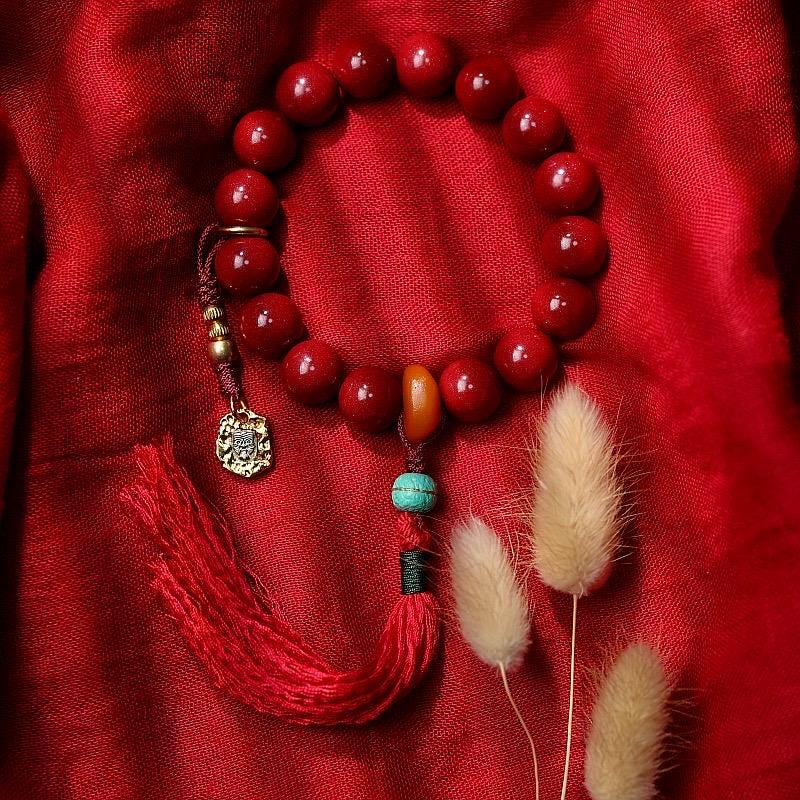
Cinnabar is the deep red mineral behind the traditional pigment vermilion. In Tibetan and Chinese bead jewellery it appears as red or purplish beads on malas, string bracelets and small charms. Because the word "cinnabar" is used loosely, it helps to know what you are actually buying before you choose one.
What cinnabar is
Cinnabar is a natural mercury sulfide. It has long been ground into red pigment for lacquer, seals and painting, including the mineral colours used on some Tibetan thangkas and tsa tsa. In Chinese folk tradition the red colour is commonly explained as auspicious and protective, which is why cinnabar beads are often paired with red string or blessing charms. These are cultural meanings, not guaranteed effects.
Natural, composite and "cinnabar" lacquer
Solid natural cinnabar is soft and brittle (about 2 to 2.5 on the Mohs scale), so it is rarely cut into whole beads. Most cinnabar jewellery falls into one of these groups:
- High-content cinnabar beads: natural cinnabar particles pressed with a small amount of binder such as beeswax. Sellers usually state the cinnabar percentage.
- Composite cinnabar beads: cinnabar powder mixed with resin or another binder. These are more durable and more even in colour.
- Carved "cinnabar" lacquer: red lacquer carved in layers. The name refers to the colour; the piece may contain little or no mineral.
- Imitations: dyed resin, plastic or stone sold simply as "red beads".
None of these is "wrong" if it is described honestly. Read the material line on the listing rather than relying on the title.
Red or purple cinnabar?
Bright orange-red cinnabar is the familiar colour. "Purple cinnabar" is a trade name for darker, purplish-red material, often sold as a higher grade. Colour also depends on the binder and finish, so compare photos taken in daylight.
Cinnabar pieces in our shop
Each listing states whether the beads are a natural-cinnabar mix or a composite. Browse the full Cinnabar collection.


Choosing size and style
- Bead size: 8 mm (0.31 in) beads suit a 108-bead mala or a slim stacked bracelet; 10 mm (0.39 in) beads read as a bolder single bracelet.
- Fit: many string bracelets adjust to about 14 to 18 cm (5.5 to 7.1 in). Measure your wrist and add 1 to 2 cm (0.4 to 0.8 in) for comfort.
- Style: a full mala works for recitation or as a long necklace; a red string bracelet with a single cinnabar bead or silver mantra charm is the quietest everyday option.
Safe wear and care
Because cinnabar contains mercury, treat it as decorative jewellery only:
- Never chew, grind, drill, sand or heat the beads, and never use them in food, drink or remedies.
- Keep beads and small parts away from young children and pets.
- Remove before washing, swimming, sleeping or exercise; avoid perfume and cleaning products.
- Wipe with a soft dry cloth and store separately so harder beads do not scratch the surface.
- Wash your hands if a bead chips, and retire a damaged piece rather than repairing it with abrasives.
Quick checklist
Check the stated material and cinnabar content, the bead size in millimetres and inches, the wrist range, and the care notes. If you want a mala for daily counting, a composite strand is the practical choice; if you prefer a high-content piece, choose a bracelet you will wear gently.


