

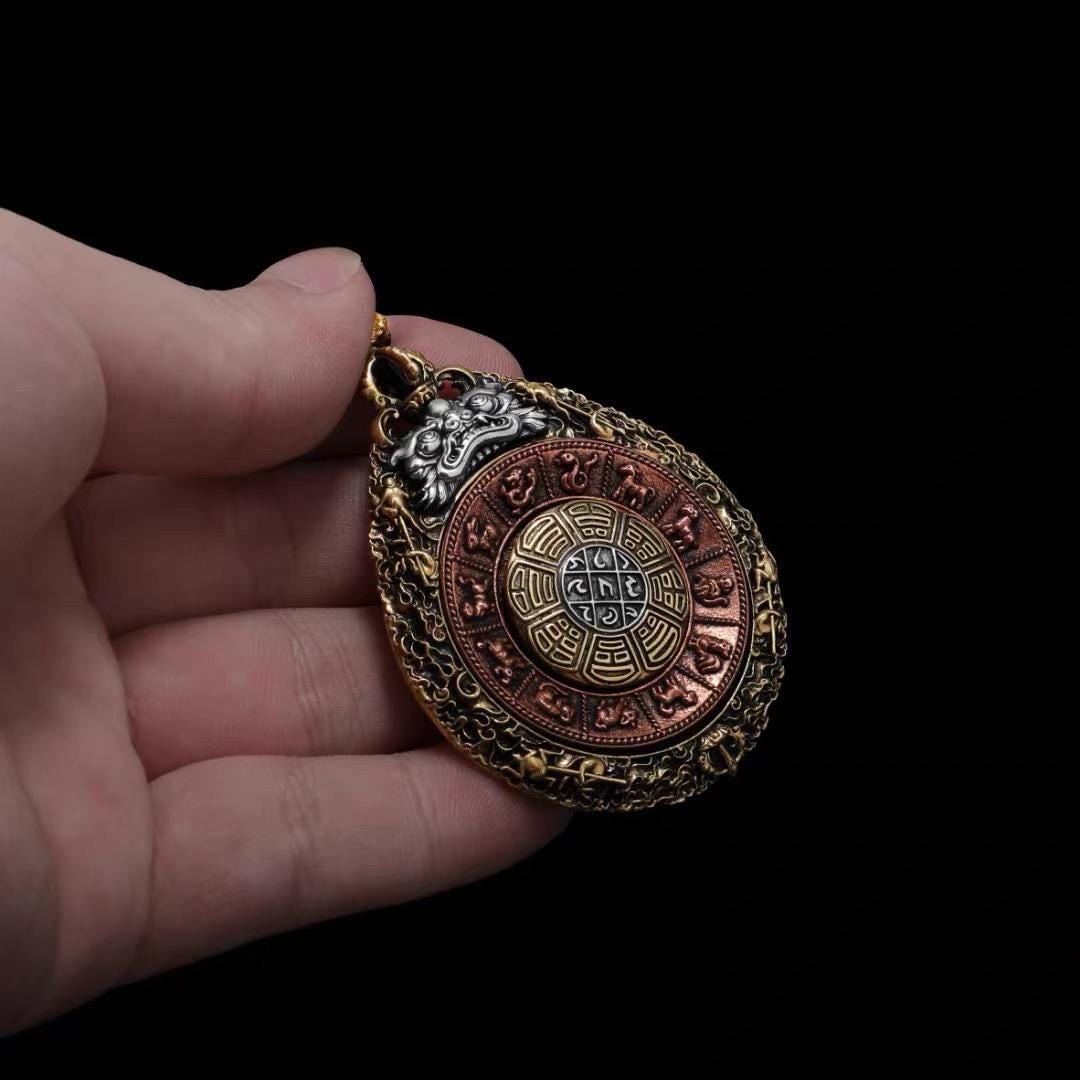
The black-and-white yin yang circle is one of the most recognised symbols in the world, and the bagua, its ring of eight trigrams, often appears around it. Both turn up on pendants, bracelets and amulets. Here is what they stand for and how to choose a piece.
What yin yang means
Yin and yang come from Chinese philosophy. They describe two complementary sides of everything: yin is commonly linked with the dark, the quiet, the receptive and the earth; yang with the light, the active and the heavens. Neither is good or bad, and each needs the other.
The familiar symbol shows them as two halves of a circle, curving into each other. A common explanation of the small dot of each colour inside the other is that every state already holds the seed of its opposite. Worn as jewellery, it is usually a reminder of balance.
What the bagua is
Bagua means "eight trigrams". Each trigram is a stack of three lines: an unbroken line stands for yang and a broken line for yin. The eight possible combinations are traditionally linked with heaven, earth, thunder, water, mountain, wind, fire and lake, and they form the basis of the Yijing (I Ching). On jewellery they are usually arranged in a ring around a yin yang centre.
You will also see the trigrams on Tibetan amulets. Tibetan astrology, which drew on Chinese sources, uses the eight trigrams (parkha) together with a nine-square number grid (mewa). This is why some Tibetan pendants are described as "nine palace, eight trigrams".
Yin yang and bagua jewellery in our shop
Pendants and bracelets with the symbols of balance. See more pendants in our Amulet collection.


How to choose
Pendant or bracelet
- Bagua pendant: the full eight-trigram design needs space to be legible. Our rotating bagua pendant measures 6 × 4.5 cm (2.4 × 1.8 in) and its centre turns. It is a statement piece worn on its own; the cord or chain is not included unless you select one.
- Small yin yang pendant: a carved stone piece of around 3.7 × 2.2 cm (1.5 × 0.9 in), such as our white and cyan jade pendant on an adjustable 55 cm (21.7 in) cord, is quieter and suits daily wear.
- Bracelets: a single yin yang charm on beads or red string is the subtlest choice.
For couples
Yin yang couple bracelets come as a pair: one with the dark half, one with the light half. Our hematite pair fits wrists of 16 to 23 cm (6.3 to 9.1 in). Check both wearers' wrist sizes before ordering; see our couple bracelet guide if you need two different sizes.
Material
- Black obsidian: natural volcanic glass with a deep shine. It can chip if knocked against hard surfaces.
- Hematite: heavy and metallic grey. Keep it dry, as moisture can dull or mark the surface.
- Jade: smooth and cool to the touch; avoid hard knocks.
- Brass and silver alloy: darkens with time; wipe with a soft dry cloth.
Wearing it with respect
Yin yang and the bagua are part of living Chinese and Daoist traditions, and the trigrams have their place in Tibetan astrology. They are welcome to anyone who appreciates their meaning. Take jewellery off for showering, swimming and sleep, and store stone pieces separately so they do not scratch one another.


